The boat
The Boys in the BoatThe boat is Joe Rantz’s name for a form of belonging that cannot be reduced to a racing shell or its crew. It joins the physical work of rowing to the nine young men’s shared trust and effort, and gives shape to a moment of unity that Joe remembers as more beautiful than any victory. In the book, the phrase also becomes a principle of narration: Joe insists that the story of his rowing days must be about more than him alone.
More than a shell or a crew
When Joe later recalls his University of Washington rowing career, he speaks of shells and oars, tactics and technique, cold hours on the water, narrow escapes from defeat, and the journey to Germany, where the crew marched into the Olympic Stadium in Berlin under Adolf Hitler’s eyes. Those memories do not make him cry. His composure fails when he tries to explain the boat.
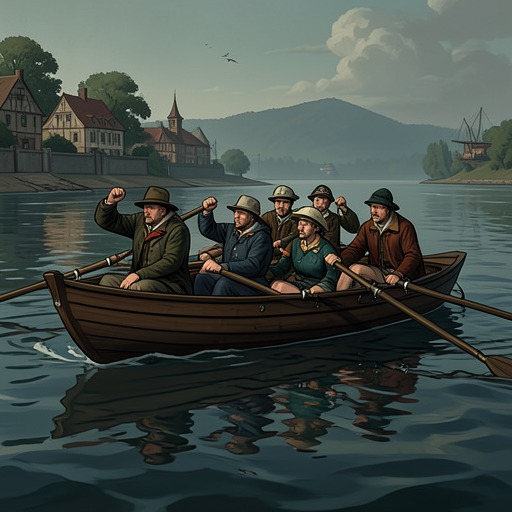
The narrator initially wonders whether Joe means the Husky Clipper, the racing shell in which he won Olympic glory, or the improbable group of teammates who achieved that feat. The answer encompasses both but exceeds them: the boat is a shared experience, a singular interval in which nine young men strove together, pulled together as one, and gave everything for one another. Pride, respect, and love bind them beyond the physical shell and the crew’s roster. Joe’s tears hold both the pain of losing that vanished moment and his sense of its beauty.
The distinction matters to the book’s account of achievement. The shell and the crew are necessary, concrete parts of rowing, but neither alone explains what Joe means. The boat names the relation among them—the collective work that turns separate bodies and individual effort into a common act.
The first glimpse of belonging
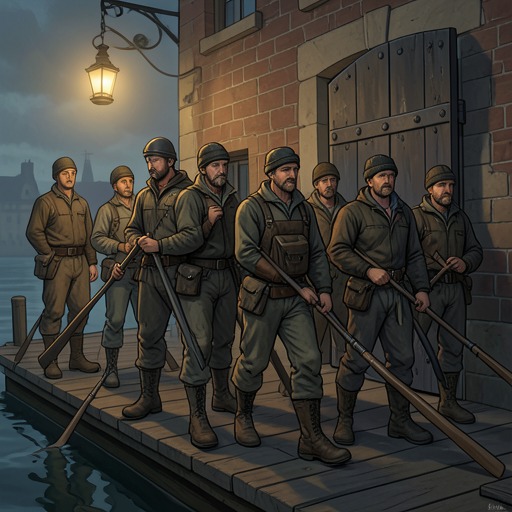
The phrase’s meaning is foreshadowed in Joe’s first row with the freshman first boat. After selection, the boys lift a shell from its rack and carry it down to the lake for a celebratory row. In the cold, they travel through the Cut and Portage Bay to Lake Union, away from the more exposed water of Lake Washington. As the shell moves across the dark water, city traffic recedes; Joe hears the coxswain’s calls and feels the regular slide of his seat and the smooth pull of his arms and legs.
At the north end of the lake, the coxswain calls, “Way . . . ’nuff!” The oars trail in the water as the shell glides to a stop. The rowers sit breathing heavily, and their breath remains synchronized even after they have stopped rowing. For Joe, they seem, briefly, to be part of a single living thing. Lights from the Aurora Bridge, downtown, and Queen Anne Hill shimmer across the scene. He turns toward the water and tries to hide his tears by fiddling with his oarlock. Since his family had left him, he had not felt this shift: for a few moments, the boat gives him an experience of connection that he cannot yet explain.
The later recollection and this early scene illuminate one another. The young Joe experiences the boat before he can define it; the older Joe struggles to put words to what that experience became. In both, synchronized effort and breath make togetherness tangible, while the emotion arrives in a pause rather than in the contest itself.
A story that must be shared
The book frames its account of Joe through a later conversation with him. As the narrator listens to Joe recall hardship and his young adulthood during the Great Depression, Joe speaks haltingly, with his daughter cautiously prompting him. His voice sometimes fades into silence. It is the rowing memories, and especially the boat, that bring him close to tears.
When the narrator asks to return and write about Joe’s rowing days, Joe agrees, then gently corrects the proposed focus: “But not just about me. It has to be about the boat.” The request makes the phrase more than a memory or an image from one night on the water. It sets the terms for the story that follows. Joe’s life remains central, but his achievement becomes legible through the shared labor and relationships that made it possible.
The recovered gold medal provides a parallel image of what can be hidden and found again. Years after it disappeared, the family discovered it concealed in insulation in the attic, apparently carried there by a squirrel for its nest. The narrator sees in its long concealment an echo of Joe’s story, kept out of sight for too long. The medal can stand for an individual triumph; Joe’s insistence redirects attention from the object of victory to the collective experience the victory cannot contain.
Collective achievement and its boundaries
The boat’s meaning belongs to a sport with a large public and institutional history. In the 1920s and 1930s, collegiate crew attracted extensive press coverage and crowds, while western interest gathered around the rivalry between the University of Washington and the University of California, Berkeley. Tens of thousands turned out for their annual April regattas. The western programs had begun to win recognition, but they remained short of the money and patronage available to eastern rowing institutions. Washington’s 1923 Poughkeepsie rowing championship victory marked a striking breach in eastern dominance.
That history also complicates any image of rowing as a world of effortless fellowship. The eastern tradition presented the sport as a gentleman’s pursuit, and the Henley Royal Regatta excluded people who earned wages as mechanics, artisans, or laborers; Australian policemen were barred under that rule and left for Berlin determined to race. Meanwhile, the British Olympic crew drew its strength from the elite rowing worlds of Oxford and Cambridge. The boat, as Joe remembers it, is built on cooperation among its rowers, but the wider institutions of the sport could define who was entitled to participate. Its emotional ideal of shared effort therefore exists within a competitive culture marked by class boundaries.
The phrase ultimately gathers several scales of meaning: the shell moving through water, the crew’s coordinated physical work, the bonds among nine young men, and a fleeting sense of belonging that survives as memory. Joe’s insistence that the book be about the boat keeps its account of achievement from becoming a solitary hero’s story. What endures is not only that the crew won, but that, for a short time, its members pulled together as one.